Abstract
Collegiate student-athletes represent a distinct medical school applicant population balancing intensive athletic training with academic and extracurricular preparation. The objective of this retrospective cross-sectional study was to examine how collegiate athletic participation and intensity relate to academic performance, experiential engagement, and medical school matriculation. We analyzed 276,858 applicants from the 2018–2022 American Medical College Application Service cycles using deidentified national data. Applicants were classified as athletes using a conservative threshold of collegiate athletic hours. Academic metrics, experiential profiles, and admissions outcomes were compared between student-athletes and non-student-athletes and between matriculated and non-matriculated student-athletes. To evaluate time-allocation tradeoffs, zero-inflated negative binomial models distinguished factors associated with athletic participation from those associated with athletic intensity. Student-athletes comprised 10% of applicants and demonstrated higher acceptance and matriculation rates than non-athletes, with comparable MCAT scores and only slightly lower grade point averages. Among student-athletes, matriculation was associated with stronger academic performance and greater engagement in research and medical community service. Modeling demonstrated that broad academic and service involvement was associated with athletic participation, whereas greater research, teaching, service, and non-medical employment involvement was associated with lower athletic intensity, reflecting measurable time-allocation tradeoffs. Paid medical employment was uniquely compatible with sustained athletic involvement. These findings suggest that differences in student-athlete application profiles arise from structural time constraints inherent to collegiate sport training environments rather than deficits in motivation or ability, highlighting implications for trainee workload, wellbeing, and equitable preparation pathways.
|
Published in
|
American Journal of Medical Education (Volume 2, Issue 1)
|
|
DOI
|
10.11648/j.mededu.20260201.12
|
|
Page(s)
|
15-27 |
|
Creative Commons
|

This is an Open Access article, distributed under the terms of the Creative Commons Attribution 4.0 International License (http://creativecommons.org/licenses/by/4.0/), which permits unrestricted use, distribution and reproduction in any medium or format, provided the original work is properly cited.
|
|
Copyright
|
Copyright © The Author(s), 2026. Published by Science Publishing Group
|
Keywords
Medical School Admissions, Student-Athletes, Premedical Advising, Extracurricular Activities, Matriculation Outcomes
1. Introduction
Medical school admissions are demanding for all applicants, but collegiate student-athletes face additional challenges related to the substantial time, physical, and mental demands of competitive athletics. Despite these pressures, multiple studies suggest that former student-athletes perform at a high level during medical training, particularly in high-stress specialties such as emergency medicine and orthopedic surgery
| [1] | Strowd, L. C., Gao, H., O'Brien, M. C., Reynolds, P., Grier, D., & Peters, T. R. (2019). Performing under pressure: Varsity athletes excel in medical school. Medical Science Educator. 29(3), 715–720. https://doi.org/10.1007/s40670-019-00730-4 |
| [2] | Spitzer, A., Gage, M., Looze, C., Walsh, M., Zuckerman, J., & Egol, K. (2009). Factors associated with successful performance in an orthopaedic surgery residency. The Journal of Bone & Joint Surgery. 91(11), 2750–2755.
http://doi.org/10.2106/JBJS.H.01243 |
[1, 2]
. Prior work from Washington University and Wake Forest University has demonstrated that medical students with collegiate athletic experience outperform their peers on standardized examinations, including the United States Medical Licensing Examinations, and receive higher clinical and faculty evaluations during training
| [1] | Strowd, L. C., Gao, H., O'Brien, M. C., Reynolds, P., Grier, D., & Peters, T. R. (2019). Performing under pressure: Varsity athletes excel in medical school. Medical Science Educator. 29(3), 715–720. https://doi.org/10.1007/s40670-019-00730-4 |
| [3] | Chole, R. A., & Ogden, M. A. (2012). Predictors of future success in otolaryngology residency applicants. Archives of Otolaryngology–Head & Neck Surgery. 138(8), 707–712.
http://doi.org/10.1001/archoto.2012.1374 |
| [4] | Claessen, F. M. A. P., Beks, R. B., Schol, I., & Dyer, G. S. (2019). What predicts outstanding orthopedic residents among the program? Archives of Bone and Joint Surgery. 7(6), 478–483. https://doi.org/10.22038/abjs.2019.23221.1615 |
[1, 3, 4]
. Parallels between the skill sets required for high-level athletics and medicine may help explain these findings. Medical trainees with athletic backgrounds demonstrate improved surgical skill proficiency, lower burnout, and greater sustained motivation compared with nonathlete peers
| [5] | Anderson, K. G., Lemos, J., Pickell, S., Stave, C., & Sgroi, M. (2023). Athletes in medicine: A systematic review of performance of athletes in medicine. Medical Education. 57(9), 807–819. https://doi.org/10.1111/medu.15033 |
| [6] | Camp, C. L., Wang, D., Turner, N. S., Grawe, B. M., Kogan, M., & Kelly, A. M. (2019). Objective predictors of grit, self-control, and conscientiousness in orthopaedic surgery residency applicants. Journal of the American Academy of Orthopaedic Surgeons. 27(5), e227–e234.
https://doi.org/10.5435/JAAOS-D-17-00545 |
[5, 6]
. These outcomes are thought to reflect transferable attributes developed through athletics, including resilience, effective time management, receptiveness to feedback, team-based collaboration, and the ability to perform under pressure.
Although student-athletes demonstrate strong performance in medical education, they remain underrepresented among medical school applicants and matriculants. Collegiate athletics requires substantial time and energy, which may compete with opportunities to participate in key premedical activities such as research, clinical exposure, and community service. AAMC admissions guidance suggests that collegiate athletic participation is generally regarded as among the less influential categories of applicant experiences in medical school admissions
. In an effort to regulate the time demands placed on student-athletes, the National Collegiate Athletic Association (NCAA) limits in-season participation to a maximum of twenty hours per week of countable athletically related activities and no more than four hours per day, with off-season involvement capped at eight hours per week. However, this rule does not reflect the true workload shouldered by student-athletes. The twenty hour limit excludes travel time, injury treatment and rehabilitation, compliance meetings, nutrition sessions, sports psychology work, and optional workouts. As a result, the regulatory framework substantially underestimates the actual time student-athletes commit to their sport. This discrepancy is supported by the NCAA Growth, Opportunities, Aspirations and Learning of Students in College Study (GOALS), which consistently shows that student-athletes across all divisions exceed twenty hours of weekly sport involvement
. When layered onto full academic schedules, these uncounted responsibilities leave limited discretionary time for applicants to pursue clinical exposure, service, research, and other experiences emphasized in medical school admissions. This challenge is further amplified by current admissions norms, as 93% of medical school applicants report healthcare volunteering, 95% report physician shadowing, and approximately 60% participate in laboratory research during college
.
The extent of this time compression becomes clear when considering how student-athletes spend the 168 hours available in a week. Across divisions, NCAA data indicate that collegiate student-athletes devote an average of 32 hours per week to official athletics during the competitive season, with an additional 29 hours spent on non-countable athletic commitments such as voluntary workouts, training room treatment, and team travel
. These time commitments are comparable to full-time employment, reinforcing the characterization of collegiate athletics as an occupational-like workload environment. In parallel, students spend approximately 40 hours per week on academic coursework, 15 hours socializing, and require an estimated 49 hours per week of sleep to meet the minimum of seven hours per night recommended by the American Academy of Sleep Medicine
| [8] | National Collegiate Athletic Association. (2020). 2020 GOALS study results shared at NCAA convention.
https://www.ncaa.org/news/2020/1/23/2020-goals-study-results-shared-at-ncaa-convention.aspx |
| [10] | CBS Sports. (2015). Student-athlete time demands.
https://sports.cbsimg.net/images/Pac-12-Student-Athlete-Time-Demands-Obtained-by-CBS-Sports.pdf |
| [11] | Watson, N. F., Badr, M. S., Belenky, G., Bliwise, D. L., Buxton, O. M., Buysse, D., Dinges, D. F., Gangwisch, J., Grandner, M. A., Kushida, C., Malhotra, R. K., Martin, J. L., Patel, S. R., Quan, S. F., & Tasali, E. (2015). Recommended amount of sleep for a healthy adult: A joint consensus statement of the American Academy of Sleep Medicine and Sleep Research Society. Sleep. 38(6), 843–844.
https://doi.org/10.5665/sleep.4716 |
[8, 10, 11]
. In the 2019 NCAA GOALS study, student-athletes reported averaging only 6 hours and 15 minutes of sleep on in-season weeknights, well below recommended levels
.
Notably, nearly 40% of Division I student-athletes report routinely obtaining less than the recommended amount of sleep, reflecting physiologic strain from competing academic and athletic demands within collegiate sport settings that function as occupational-like workload environments and sources of environmental stressors
| [12] | Mah, C. D., Kezirian, E. J., Marcello, B. M., & Dement, W. C. (2018). Poor sleep quality and insufficient sleep of a collegiate student-athlete population. Sleep Health. 4(3), 251–257.
https://doi.org/10.1016/j.sleh.2018.02.005 |
| [13] | Sato, S., Kinoshita, K., Kondo, M., Yabunaka, Y., Yamada, Y., & Tsuchiya, H. (2023). Student athlete well-being framework: an empirical examination of elite college student athletes. Frontiers in Psychology. 14, 1171309.
https://doi.org/10.3389/fpsyg.2023.1171309 |
[12, 13]
. These sleep deficits and stress exposures arise within the broader collegiate athletic context, where institutional scheduling demands, travel requirements, and academic workload jointly shape student-athlete wellbeing and available discretionary time
| [14] | Grandner, M. A., Hall, C., Jaszewski, A., Alfonso-Miller, P., Gehrels, J. A., Killgore, W. D. S., & Athey, A. (2021). Mental health in student athletes: Associations with sleep duration, sleep quality, insomnia, fatigue, and sleep apnea symptoms. Athletic Training and Sports Health Care. 13(4), e159–e167.
https://doi.org/10.3928/19425864-20200521-01 |
| [15] | Wilson, Sandy & Gooderick, Julie & Driller, Matthew & Jones, Martin & Draper, Stephen & Parker, John. (2025). Sleep health in the student-athlete: A narrative review of current research and future directions. Current Sleep Medicine Reports. 11, 26. http://doi.org/10.1007/s40675-025-00341-z |
| [16] | Beisecker, L., Harrison, P., Josephson, M., & DeFreese, J. D. (2024). Depression, anxiety and stress among female student-athletes: A systematic review and meta-analysis. British Journal of Sports Medicine. 58(5), 278–285.
https://doi.org/10.1136/bjsports-2023-107328 |
[14-16]
. Consistent with this high-demand context, student-athletes report elevated academic stress levels even during routine academic periods, indicating persistently high workload strain within this population
| [17] | Gerlach, J. M. The lived experiences of academic advisors with counseling degrees in addressing wellness with college student-athletes. Ph.D. Thesis, Virginia Commonwealth University, 2017. |
[17]
. Recent NCAA data indicate that academic pressures, future planning concerns, and financial stress are among the most commonly reported factors negatively affecting student-athlete mental health
. Together, these obligations account for the vast majority of available weekly time and illustrate the structural challenge student-athletes face when attempting to build medical school applications that require longitudinal involvement in patient care, research, and community engagement. Athletic time demands have been shown to restrict participation in laboratories, internships, and other experiential-learning activities. Approximately 14–20% of student-athletes report that they wished to participate in internships but were unable to do so because of athletic commitments
. Consistent with these constraints, approximately half of student-athletes report difficulty scheduling desired courses around athletic commitments
| [19] | Gurney, G., Sack, A., Lopiano, D., Meyer, J., Porto, B., Ridpath, D. B., Willingham, M., & Zimbalist, A. (2016). The Drake Group position statement: Excessive athletics time demands undermine college athletes’ health and education and require immediate reform. The Drake Group.
http://thedrakegroup.org/ |
[19]
. Athletic scheduling demands also influence academic trajectories, with roughly 31% of student-athletes reporting that sport participation limited their choice of academic major
| [19] | Gurney, G., Sack, A., Lopiano, D., Meyer, J., Porto, B., Ridpath, D. B., Willingham, M., & Zimbalist, A. (2016). The Drake Group position statement: Excessive athletics time demands undermine college athletes’ health and education and require immediate reform. The Drake Group.
http://thedrakegroup.org/ |
[19]
.
These combined academic and athletic demands are reflected in survey findings showing that nearly 80% of student-athletes report feeling overwhelmed by their responsibilities at some point during the academic year
| [20] | Holden, S. L., Forester, B. E., Williford, H. N., & Reilly, E. (2019). Sport locus of control and perceived stress among college student-athletes. International Journal of Environmental Research and Public Health. 16(16), 2823.
https://doi.org/10.3390/ijerph16162823 |
[20]
. Similarly, NCAA data indicate that roughly one-quarter to one-third of student-athletes report experiencing difficulties that feel overwhelming within a given month
. More recent NCAA data similarly show that up to 44% of women athletes and 17% of men athletes report feeling overwhelmed most or every day during the academic year
. Even in the off-season, athletic commitments remain substantial, with 67% of student-athletes reporting that they devote as much or more time to athletics as they do in-season
. These time demands indicate that student-athletes operate within a markedly compressed weekly schedule compared with nonathletes, which may limit opportunities to pursue the extracurricular activities typically emphasized in medical school admissions and reflects the constrained time environment in which collegiate student-athletes operate
| [21] | Avery, C., Shipherd, A. M., Gomez, S., & Barczarenner, K. (2022). Exploring stress mindset and perceived stress between college student-athletes and non-athletes. International Journal of Exercise Science. 15(5), 1554–1562.
https://doi.org/10.70252/JTAJ7044 |
[21]
. Student-athlete engagement is therefore shaped not only by individual motivation but also by institutional structures such as training schedules, travel demands, and access to academic and support resources across athletic programs
| [22] | Wycliffe, N., & Njororai Simiyu, W. (2010). Individual and institutional challenges facing student athletes on US college campuses. Journal of Physical Education and Sports Management. 1, 16–24.
http://hdl.handle.net/10950/457 |
| [23] | Gayles, J. G., & Hu, S. (2009). The influence of student engagement and sport participation on college outcomes among student-athletes: An institutional and individual perspective. Research in Higher Education. 50(4), 315–333.
https://doi.org/10.1007/s11162-009-9127-2 |
[22, 23]
. At the same time, the skills cultivated through athletics, including discipline, resilience, teamwork, communication, and time management, align closely with core competencies valued in medical training. Consistent with this, more than 85–90% of student-athletes report that athletic participation enhances transferable skills such as responsibility, work ethic, teamwork, and time management
.
Recognizing these challenges, the NCAA, the Association of American Medical Colleges (AAMC), and the National Institutes of Health (NIH) have introduced the Athlete to Medicine initiative to increase visibility of career pathways in the health professions for collegiate athletes. Despite this national attention, the specific barriers student-athletes encounter in the medical school application process remain poorly characterized. Little is known about how athletic commitments shape applicants academic metrics, experiential profiles, or likelihood of matriculation. A clearer understanding of these relationships is essential for guiding effective mentorship and addressing potential disparities in access to medical education.
In this study, we analyze five years of AAMC application data to examine how athletic participation relates to academic performance, extracurricular involvement, and medical school matriculation. We also identify characteristics that distinguish matriculated athletes from non-matriculated athletes and explore which activities athletes are best able to integrate alongside the demands of collegiate sport. This information can guide advisors and mentorship programs in helping student-athletes prepare competitive and well-rounded applications to medical school.
2. Materials and Methods
2.1. Data Collection
This study is a retrospective review of 276,858 medical school applicants from the 2018 to 2022 AAMC application cycles. Data was requested directly from the AAMC and provided in deidentified form. The variables obtained for analysis included demographic information such as hours of collegiate athletic participation, age at application, first-time applicant status, gender, race/ethnicity, and residency status. Additional variables included acceptance and matriculation outcomes, grade point average, Medical College Admission Test score (MCAT), and hours reported in all major extracurricular categories as summarized in
Table 1.
Table 1. Applicant Demographics and Characteristics by Athlete Status.
Variable | Athletes (N = 28,722) | Non-Athletes (N = 248,086) | p valuea |
Age, y | | | | | <0.0001* |
<22 | 753 | (2.6) | 12,979 | (5.2) | |
22-24 | 18,806 | (65.5) | 151,747 | (61.2) | |
25-27 | 6,936 | (24.1) | 53,873 | (21.7) | |
>27 | 2,227 | (7.8) | 29,487 | (11.9) | |
First time applicant | 7,677 | (26.7) | 67,353 | (27.1) | 0.1309 |
Gender | | | | | <0.0001* |
Female | 14,647 | (51.0) | 135,054 | (54.4) | |
Male | 14,052 | (48.9) | 112,808 | (45.5) | |
Other | 23 | (0.1) | 224 | (0.1) | |
Race/Ethnicity | | | | | <0.0001* |
Asian | 2,566 | (8.9) | 57,083 | (23.0) | |
Black of African American | 1,992 | (6.9) | 22,313 | (9.0) | |
Hispanic/Latino/Spanish | 1,098 | (3.8) | 16,176 | (6.5) | |
American Indian/Alaska Native | 55 | (0.2) | 415 | (0.2) | |
Native Hawaiian/Pacific Islander | 27 | (0.1) | 202 | (0.1) | |
White | 17,884 | (62.3) | 101,740 | (41.0) | |
Other | 342 | (1.2) | 6,264 | (2.5) | |
Mixed | 2,991 | (10.4) | 25,195 | (10.2) | |
Unknown | 1,767 | (6.2) | 18,698 | (7.5) | |
Permanent Resident | 27,957 | (97.3) | 238,901 | (96.8) | <0.0001* |
Acceptance | 13,051 | (45.4) | 102,745 | (41.4) | <0.0001* |
Matriculation | 12,474 | (43.4) | 98,632 | (39.8) | <0.0001* |
a Results of Chi-squared test.
* p < 0.05
Note: Values are n (%). Athlete defined as ≥252 annual athletic participation hours.
2.2. Classification of Athletic Participation
The AAMC dataset contained self-reported hours of participation in collegiate athletics that ranged from 0 to 99,999 hours. To determine a valid threshold for classifying applicants as athletes or non-athletes, we consulted the NCAA research team and obtained information from the 2019 National Collegiate Athletic Association GOALS study
| [6] | Camp, C. L., Wang, D., Turner, N. S., Grawe, B. M., Kogan, M., & Kelly, A. M. (2019). Objective predictors of grit, self-control, and conscientiousness in orthopaedic surgery residency applicants. Journal of the American Academy of Orthopaedic Surgeons. 27(5), e227–e234.
https://doi.org/10.5435/JAAOS-D-17-00545 |
[6]
. The NCAA provided mean and standard deviation values for weekly in-season athletic participation across Divisions I, II, and III. The lowest mean occurred in Division III athletes, who reported an average of 31.79 hours per week with a standard deviation of 14.94 hours. Using one standard deviation below the Division III mean to establish a conservative threshold, and assuming a fifteen week season, we calculated a threshold of 252.75 hours per season. This value was rounded down to 252 hours to serve as the cut-off point for student-athlete classification. Using a conservative participation threshold reduces misclassification by ensuring that only applicants with sustained intercollegiate athletic engagement are categorized as athletes, thereby improving internal validity of group comparisons. Applicants who reported 252 or more hours were classified as student-athletes, and those who reported zero or fewer than 252 hours were classified as non-athletes.
2.3. Statistical Analysis
We created three primary comparison groups to evaluate differences in application characteristics. These groups included athletes versus non-athletes, matriculated athletes versus matriculated non-athletes, and matriculated athletes versus non-matriculated athletes. Chi-squared tests and two-sample t-tests were used to examine differences in demographic, academic, and experiential variables across groups.
Applicants with missing key variables, including athletic hours left blank, GPA, MCAT scores, or matriculation status, were excluded using complete-case analysis, while applicants reporting zero athletic hours were retained and classified as non-athletes. Extreme outliers were identified using prespecified plausibility thresholds and percentile inspection. Two athletic hour values of 300,000 and 400,000, one publication hour value of approximately 1,000,000, and two physician-shadowing values exceeding 200,000 were excluded as implausible. These exclusions represented less than 0.01% of the sample and were performed prior to regression modeling.
To evaluate the relationship between athletic hours and other experiential hours, we used a zero-inflated negative binomial regression. This modeling approach addressed both the large number of applicants with zero athletic hours and the overdispersion present in the athletic hour distribution. The count component estimated the association between non-athletic experiential hours and the number of athletic hours among applicants who participated in athletics. The zero-inflated component estimated predictors of having any athletic participation at all. All experiential variables were transformed using a natural logarithm plus one transformation to reduce skewness and stabilize variance, and extreme outliers were removed prior to analysis to improve model fit. All analyses were conducted using IBM SPSS Statistics version 25.0 (IBM Corp., Armonk, NY), and statistical significance was defined using two-sided tests with an alpha level of 0.05.
2.4. Ethical Considerations
This study was approved by the University of Nevada, Reno Institutional Review Board (IRBNet #2251050-1) and classified as exempt due to the use of fully deidentified secondary data obtained through institutional agreement with the American Medical College Application Service. No identifiable information was accessed. The requirement for informed consent was waived by the Institutional Review Board. The study was conducted in accordance with the Declaration of Helsinki and its subsequent amendments.
3. Results
Between 2018 and 2022, a total of 28,722 applicants met the criteria for athletic participation, representing 10% of all applicants, while 248,086 applicants, representing 90%, were classified as non-athletes. As shown in (
Table 1), student-athletes had higher acceptance and matriculation rates compared to non-athletes. A total of 45.4% of student-athletes were accepted compared to 41.4% of non-athletes, and 43.4% of student-athletes matriculated compared to 39.8% of non-athletes. Demographic differences were also observed and can be found in (
Table 1). A larger proportion of student-athletes fell within the 22 to 24 year age range.
Table 2 shows characteristics of matriculated applicants stratified by athletic status. Matriculated student-athletes had a slightly lower mean grade point average than matriculated non-athletes (3.71 vs 3.74), but nearly identical MCAT scores (511.7 vs 511.6). Student-athletes reported significantly higher hours of paid medical employment than non-athletes (1,325 vs 1,179), with no differences in paid non-medical employment. Research hours were similar between groups (1,112 vs 1,093), and no significant differences were found in presentation hours, publication hours, or physician shadowing hours. Non-athletes reported more teaching hours than student-athletes (238 vs 209). Demographic patterns were consistent with the full applicant pool.
Table 2. Characteristics of Matriculated Applicants by Athlete Status.
Variable | Athletes (N = 12,474) mean ± SD | Non-Athletes (N = 98,632) mean ± SD | p valuea |
GPA | 3.71 ± 0.24 | 3.74 ± 0.24 | <0.0001* |
Paid medical employment hours | 1,325 ± 2,411 | 1,179 ± 2,759 | <0.0001* |
Paid nonmedical employment hours | 1,179 ± 2,620 | 1,177 ± 3,128 | 0.9450 |
Medical community service hours | 302 ± 1,476 | 311 ± 850 | 0.3017 |
Nonmedical community service hours | 367 ± 2,247 | 355 ± 1,446 | 0.3829 |
Presentation hours | 24.1 ± 902.6 | 17.8 ± 453.8 | 0.2032 |
Publication hours | 63.0 ± 478.0 | 63.9 ± 3,269 | 0.9771 |
Research hours | 1,112 ± 1,894 | 1,093 ± 2,198 | 0.3358 |
Teaching hours | 209.0 ± 689.6 | 238.1 ± 1,007.0 | 0.0017* |
Physician shadowing hours | 128.2 ± 220.3 | 120.7 ± 522.3 | 0.1172 |
MCAT score | 511.7 ± 6.3 | 511.6 ± 6.6 | 0.0406* |
ᵃ Results of two-sample t-tests comparing athletes and non-athletes.
* p < 0.05 comparing athletes and non-athletes.
Note: Values are mean ± SD. Athlete defined as ≥252 annual athletic participation hours.
Table 3 compares matriculated and non-matriculated student-athletes and highlights characteristics associated with successful matriculation among athletic applicants. Matriculated student-athletes had higher grade point averages (3.71 vs 3.52) and higher MCAT scores (511.7 vs 503.0) than non-matriculated student-athletes. Matriculated student-athletes also accumulated more medical community service hours (302 vs 264), more research hours (1,112 vs 894), and slightly more teaching hours (209 vs 190). No significant differences were observed in presentation hours or publication hours. Paid medical employment hours were lower among matriculated student-athletes compared to non-matriculated student-athletes (1,325 vs 1,639), while paid non-medical employment showed no meaningful difference. Shadowing hours were similar between groups.
Table 3. Characteristics of Student-Athletes by Matriculation Status.
Variable | Matriculated (N = 12,474) mean ± SD | Non-Matriculated (N = 16,248) mean ± SD | p valuea |
GPA | 3.71 ± 0.24 | 3.52 ± 0.33 | <0.0001* |
Paid medical employment hours | 1,325 ± 2,411 | 1,639 ± 3,176 | <0.0001* |
Paid nonmedical employment hours | 1,179 ± 2,620 | 1,493 ± 4,055 | <0.0001* |
Medical community service hours | 302 ± 1,476 | 264 ± 1,604 | 0.0371* |
Nonmedical community service hours | 367 ± 2,247 | 350 ± 1,533 | 0.4394 |
Presentation hours | 24.1 ± 902.6 | 20.8 ± 196.7 | 0.6488 |
Publication hours | 63.0 ± 478.0 | 84.7 ± 1,933 | 0.2214 |
Research hours | 1,112 ± 1,894 | 772.6 ± 2,079 | <0.0001* |
Teaching hours | 209 ± 690 | 190 ± 711 | 0.0224* |
Shadowing hours | 128 ± 220 | 139 ± 714 | 0.0968 |
MCAT score | 511.7 ± 6.3 | 503.0 ± 8.7 | <0.0001* |
a Results of two-sample t-test.
* p < 0.05.
Note: Values are mean ± SD. Athlete defined as ≥252 annual athletic participation hours.
We applied a zero-inflated negative binomial (ZINB) model to examine the association between athletic hours and other experiential commitments seen in
Table 4 in the Appendix I. The distribution of athletic hours showed both overdispersion and a high proportion of zero values, supporting the use of this modeling approach to separate predictors of athletic participation from predictors of athletic hour intensity.
In the count component of the model (see Appendix I,
Table 4), several experiential variables significantly predicted the number of athletic hours. Higher paid medical employment hours were associated with a greater number of athletic hours. Higher hours in paid non-medical employment, medical community service, research, and teaching were associated with fewer athletic hours. Non-significant predictors included non-medical community service, presentation hours, publication hours, and physician shadowing hours.
In the zero-inflated component (see Appendix I,
Table 4), most experiential variables did not meaningfully alter the likelihood of having any intercollegiate athletic participation. However, higher hours of paid non-medical employment, medical and non-medical community service, research, and publication activities were associated with a greater likelihood of having any athletic participation, as reflected by lower odds of reporting zero athletic hours. In contrast, higher teaching hours were associated with a lower likelihood of athletic participation. Paid medical employment hours did not significantly influence the likelihood of athletic participation.
4. Discussion
This study demonstrates that athletic participation and the intensity of athletic involvement represent distinct dimensions of applicants’ experiences. By applying a zero-inflated negative binomial model, we were able to separately examine factors associated with whether applicants participated in intercollegiate athletics at all and factors associated with the level of athletic involvement maintained among participants. This distinction revealed that applicants engaged in a broad range of academic and service-oriented activities were more likely to have some athletic experience, while many of these same commitments compete with the time required to sustain higher levels of athletic involvement. Together, these findings highlight the complexity with which student-athletes allocate time across demanding academic, service, and employment activities.
Tradeoffs between athletics and other application-building activities are often implied in discussions of premedical preparation, yet these relationships are rarely demonstrated empirically. Rather than assuming that athletic commitments simply limit time for other experiences, we sought to explicitly characterize how athletic participation and athletic intensity relate to applicants’ broader experiential profiles. By distinguishing between whether applicants participated in athletics at all and how much athletic involvement they maintained, our analyses were able to directly demonstrate the presence of time-allocation tradeoffs that might otherwise be assumed but not measured. The sections that follow examine these patterns in greater detail by first describing factors associated with athletic participation and then exploring how different extracurricular commitments relate to the intensity of athletic involvement among participating applicants.
4.1. Participation in Athletics
Several experiential variables were associated with a greater likelihood of having any intercollegiate athletic participation. Applicants with higher involvement in community service (both medical and non-medical), research activities, publication experience, and paid non-medical employment were more likely to report some athletic participation. This pattern suggests that student-athletes often engage broadly in achievement-oriented activities, reflecting traits such as discipline, goal-directed behavior, and sustained motivation. Importantly, these associations reflect the likelihood of having any athletic experience rather than the ability to maintain high levels of athletic involvement.
The matriculation analyses provide additional insight into how these patterns translate into application outcomes. Among accepted applicants, athletes and non-athletes demonstrated nearly identical mean GPAs and MCAT scores, indicating that athletic participation does not diminish academic competitiveness. However, within the student-athlete subgroup, successful matriculation was strongly associated with higher academic performance and greater engagement in key extracurricular domains. Non-matriculated student-athletes had substantially lower GPAs and MCAT scores and reported fewer research and medical community service hours. These findings suggest that while athletic participation is common among successful applicants, strong academic performance and focused engagement in high-yield extracurricular activities remain essential for matriculation.
4.2. How Much Athletic Involvement Applicants Maintain
Among applicants who participated in athletics, the intensity of athletic involvement varied substantially depending on the types of extracurricular activities pursued. Paid medical employment was positively associated with athletic hours, suggesting that this form of work may be more compatible with athletic schedules, potentially because many student-athletes engage in clinical employment during school breaks, summer periods, or gap years. In contrast, research, teaching, medical community service, and paid non-medical employment were all associated with fewer athletic hours, reflecting the significant time-allocation tradeoffs required for these more demanding activities.
Several other activities, including shadowing, presentation hours, and non-medical community service, were not significant predictors of athletic intensity. These activities may be more flexible or episodic, allowing participation without substantially reducing athletic involvement. Their limited association with matriculation outcomes further suggests that they may consume time without meaningfully enhancing application competitiveness.
4.3. Interpreting Time-Allocation Tradeoffs and Diminishing Returns
The substantial time demands of collegiate athletics, functioning as an occupational-like workload environment, likely shape how student-athletes allocate extracurricular involvement
| [21] | Avery, C., Shipherd, A. M., Gomez, S., & Barczarenner, K. (2022). Exploring stress mindset and perceived stress between college student-athletes and non-athletes. International Journal of Exercise Science. 15(5), 1554–1562.
https://doi.org/10.70252/JTAJ7044 |
[21]
. These demands constitute a high-workload context associated with sleep disruption, fatigue, and mental health strain among collegiate athletes
| [14] | Grandner, M. A., Hall, C., Jaszewski, A., Alfonso-Miller, P., Gehrels, J. A., Killgore, W. D. S., & Athey, A. (2021). Mental health in student athletes: Associations with sleep duration, sleep quality, insomnia, fatigue, and sleep apnea symptoms. Athletic Training and Sports Health Care. 13(4), e159–e167.
https://doi.org/10.3928/19425864-20200521-01 |
| [16] | Beisecker, L., Harrison, P., Josephson, M., & DeFreese, J. D. (2024). Depression, anxiety and stress among female student-athletes: A systematic review and meta-analysis. British Journal of Sports Medicine. 58(5), 278–285.
https://doi.org/10.1136/bjsports-2023-107328 |
[14, 16]
. Many student-athletes may selectively pursue activities that can be balanced with training and competition schedules, which may explain why some experiences coexist with athletic commitments while others displace athletic hours. The positive association between paid medical employment and athletic intensity may reflect strategic time use, such as concentrating clinical work during breaks or gap years to gain medically relevant experience without compromising athletic participation. Notably, non-matriculated student-athletes reported the highest levels of paid medical employment, suggesting that very high hour accumulation in this domain may not confer proportional benefits. Rather than reflecting increased competitiveness, excessive hours may signal time pressure or limited opportunity to diversify an application. This pattern supports a calibrated interpretation of extracurricular engagement in which additional hours may reach a point of diminishing returns.
Similar trends were observed across other activities. Teaching hours demonstrated a diminishing-return pattern, with greater involvement associated with lower athletic intensity and a higher likelihood of no athletic participation, yet without meaningful differentiation between matriculated and non-matriculated student-athletes. Paid non-medical employment showed a comparable pattern, reducing athletic intensity without contributing to matriculation outcomes. Research and medical community service demonstrated a more nuanced relationship in which moderate engagement was associated with successful matriculation, whereas very high hour totals displaced athletic participation without clear additional benefit. Activities such as shadowing, presentations, and publications were consistently low-impact across analyses. Taken together, these findings indicate that extracurricular involvement may reach a threshold at which additional hours yield limited returns and may instead reflect time pressures or reduced flexibility to diversify one’s application. This underscores the importance of strategic, balanced engagement for student-athletes navigating multiple competing demands.
These time-allocation tradeoffs likely arise within broader institutional and environmental contexts. Institutional variation across collegiate athletic programs may shape these time-allocation constraints, as scheduling demands differ by division, sport, and competition structure, with higher-division contexts often imposing greater combined academic and athletic workload and associated strain among student-athletes
| [22] | Wycliffe, N., & Njororai Simiyu, W. (2010). Individual and institutional challenges facing student athletes on US college campuses. Journal of Physical Education and Sports Management. 1, 16–24.
http://hdl.handle.net/10950/457 |
| [25] | Brown, B. J., Aller, T. B., Lyons, L. K., Jensen, J. F., & Hodgson, J. L. (2022). NCAA student-athlete mental health and wellness: A biopsychosocial examination. Journal of Student Affairs Research and Practice. 59(3), 252–267.
https://doi.org/10.1080/19496591.2021.1902820 |
[22, 25]
. Socioeconomic factors also influence access to athletic participation, as elite sport pathways often require substantial financial resources prior to collegiate entry, yet many collegiate student-athletes experience financial hardship, highlighting the complex relationship between athletics, opportunity, and socioeconomic context
| [5] | Anderson, K. G., Lemos, J., Pickell, S., Stave, C., & Sgroi, M. (2023). Athletes in medicine: A systematic review of performance of athletes in medicine. Medical Education. 57(9), 807–819. https://doi.org/10.1111/medu.15033 |
[5]
. Disparities in institutional resources, including facilities, staffing, and academic support infrastructure, further affect student-athletes’ health, academic progress, and developmental opportunities across NCAA programs
| [24] | Coombs, H., & Bagley, B. (2025). Perceptions of institutional resource inequities at FCS and low-major NCAA programs. Journal of Emerging Sport Studies. 11.
https://doi.org/10.26522/jess.v11i.5012 |
[24]
. Consistent with this, only about half of student-athletes report feeling comfortable seeking mental-health support on campus, underscoring variability in institutional support environments
. These environmental inequities may shape opportunities for engagement in research and service activities valued in medical school admissions, contributing to variation in experiential profiles among student-athlete applicants.
4.4. Practical Implications for Advising Student-Athletes
These findings offer several practical recommendations for student-athletes preparing for medical school. Prior single-institution studies have described advising access, scheduling conflicts with practices and competitions, fatigue, and limited awareness of application requirements as major barriers for pre-health student-athletes
| [26] | Shabet, C., Nickel, A., Grodman, L., Lemos, J., Callow, B., Koulos, N., Berman, D., Wasco, J., & Hopson, L. (2025). Understanding the needs of undergraduate student athletes as they apply to health professional school. Michigan Journal of Medicine. 8. https://doi.org/10.3998/mjm.5286 |
[26]
. Our findings extend this work by demonstrating at a national level that these barriers are not merely perceived but are reflected in measurable tradeoffs between athletic commitments and application-building experiences.
First, students should prioritize quality over quantity, particularly in research, medical community service, and paid medical employment, domains that were consistently associated with successful matriculation. Second, student-athletes should recognize that paid non-medical employment and other low-impact activities such as shadowing and publications may require substantial time without meaningfully enhancing competitiveness. Third, because collegiate athletics cultivates transferable skills such as leadership, teamwork, communication, discipline, and resilience, student-athletes should explicitly articulate these attributes within their applications. Finally, leadership and mentorship roles within athletic teams may serve as high-value teaching experiences that align more naturally with athletic schedules than traditional teaching roles.
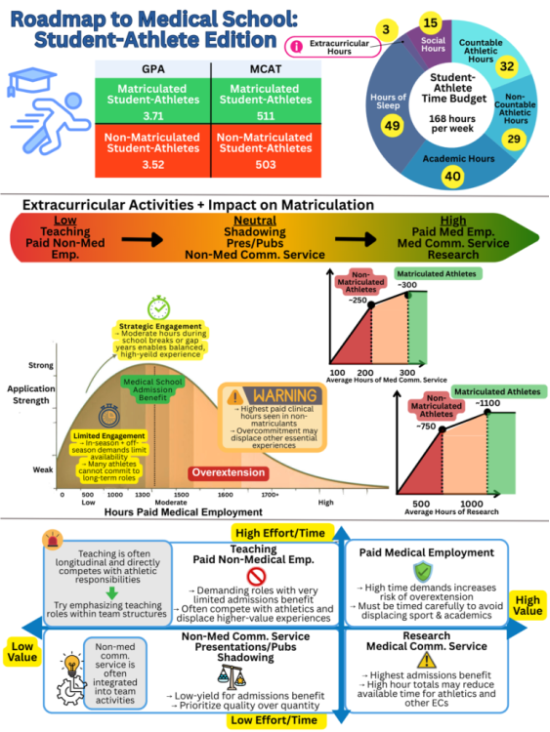
To translate these findings into a practical advising resource, we developed a visual “Roadmap to Medical School: Student-Athlete Edition” (see Appendix II,
Figure A1), which summarizes the academic benchmarks, experiential patterns, and strategic engagement recommendations identified in this study. This tool is intended to support advisors, coaches, and student-athletes in making informed decisions about how to balance athletic participation with essential application-building experiences.
4.5. Strengths, Limitations, and Future Directions
This study has several notable strengths, including its large national sample of nearly 280,000 applicants across five application cycles and its use of an analytic framework that distinguishes between athletic participation and athletic intensity. By identifying which experiences most strongly align with matriculation among student-athletes, this study addresses an important gap in the literature and provides actionable insights for advising and mentorship.
Several limitations should be considered. Experience hours were self-reported and may be subject to recall variability or institutional differences in advising practices. Hour counts cannot capture experience quality, leadership, or depth of engagement. Institutional and environmental variability across collegiate athletic programs was not directly measurable in this dataset. Prior literature demonstrates that disparities in athletic scheduling demands, facilities, staffing, and academic support resources can influence student-athletes’ health, academic engagement, and developmental opportunities
| [24] | Coombs, H., & Bagley, B. (2025). Perceptions of institutional resource inequities at FCS and low-major NCAA programs. Journal of Emerging Sport Studies. 11.
https://doi.org/10.26522/jess.v11i.5012 |
[24]
. Socioeconomic and institutional resource differences may therefore contribute to observed variation in experiential engagement among student-athlete applicants and represent an important area for future investigation. Although the zero-inflated negative binomial model appropriately addressed overdispersion and excess zero values, it assumes independence between participation and intensity processes, which may not fully reflect real-world behavior. The dataset also lacks detail regarding sport type, competitive level, or role on the team, and unmeasured factors such as mentorship access and socioeconomic support may influence outcomes. Finally, the observational design precludes causal inference.
Future work should build on these findings to strengthen student-athlete centered advising and mentorship pathways. Collaboration with athletic departments and national initiatives may support earlier planning for research, clinical exposure, and service experiences that are compatible with athletic schedules. Ultimately, the goal of this work is not only to describe applicant patterns, but to help create environments in which student-athletes can more effectively prepare strong, well-rounded applications and successfully matriculate into medical school.
5. Conclusions
This study provides one of the most comprehensive examinations to date of how collegiate athletic participation intersects with the academic and experiential factors that shape medical school admissions. By distinguishing between participation in athletics and the intensity of athletic involvement, we demonstrate that student-athletes are highly motivated and broadly engaged across many domains, yet face substantial structural constraints that limit the time available for high-yield premedical activities. While athletic experience itself is not a barrier to academic competitiveness, successful matriculation among student-athletes is most closely tied to strong academic performance and focused engagement in activities such as research and medically related community service. These findings indicate that the challenges faced by student-athletes arise not from a lack of capability or motivation, but from the finite time available within an already demanding weekly schedule.
Our findings have clear implications for advising. Student-athletes benefit from early, deliberate planning that prioritizes experiences most strongly associated with matriculation and avoids overinvestment in activities that offer limited admissions value. At the same time, the transferable skills cultivated through athletics align closely with competencies valued in medical training and should be intentionally articulated within medical school applications. Supporting student-athletes in leveraging these strengths while navigating time-intensive demands requires advising structures that recognize both the constraints and the protective potential of supportive athletic environments
| [27] | Graupensperger, S., Benson, A. J., Kilmer, J. R., & Evans, M. B. (2020). Social (un)distancing: Teammate interactions, athletic identity, and mental health of student-athletes during COVID-19. Journal of Adolescent Health. 67(5), 662–670.
https://doi.org/10.1016/j.jadohealth.2020.08.006 |
[27]
. Institutional environments that provide greater scheduling flexibility and academic support may enable student-athletes to pursue clinical, research, and service experiences more effectively alongside athletic commitments
| [23] | Gayles, J. G., & Hu, S. (2009). The influence of student engagement and sport participation on college outcomes among student-athletes: An institutional and individual perspective. Research in Higher Education. 50(4), 315–333.
https://doi.org/10.1007/s11162-009-9127-2 |
| [24] | Coombs, H., & Bagley, B. (2025). Perceptions of institutional resource inequities at FCS and low-major NCAA programs. Journal of Emerging Sport Studies. 11.
https://doi.org/10.26522/jess.v11i.5012 |
[23, 24]
.
More broadly, this work underscores the importance of admissions processes and mentorship pathways that account for variation in applicants’ available time and opportunity arising from collegiate athletic training environments that shape both educational access and long-term wellbeing and burnout risk, while athletic backgrounds may also foster adaptive coping and resilience in demanding training contexts
| [28] | Babenko, O., Mosewich, A., & Sloychuk, J. (2020). Students’ perceptions of learning environment and their leisure-time exercise in medical school: Does sport background matter? Perspectives on Medical Education. 9(2), 92–97.
https://doi.org/10.1007/s40037-020-00560-w |
[28]
. Creating environments in which student-athletes can realistically pursue meaningful clinical, research, and service experiences may help ensure that highly capable applicants are not disadvantaged by the demands of their sport. As national initiatives such as Athlete to Medicine continue to expand, data-driven insights such as those presented here can guide more equitable and effective preparation strategies for aspiring physician-athletes.
Abbreviations
NCAA | National Collegiate Athletic Association |
GOALS | Growth, Opportunities, Aspirations and Learning of Students in College Study |
AAMC | Association of American Medical Colleges |
NIH | National Institutes of Health |
MCAT | Medical College Admission Test |
GPA | Grade Point Average |
ZINB | Zero-Inflated Negative Binomial |
Med Emp | Medical Employment |
Comm Serv | Community Service |
Pres/Pubs | Presentations/Publications |
EC | Extracurricular Activities |
Acknowledgments
The authors are thankful to the University of Nevada Reno School of Medicine and the Association of American Medical Colleges for providing support for this work.
Author Contributions
Arianna Gregg: Conceptualization, Data curation, Formal Analysis, Funding acquisition, Investigation, Methodology, Project administration, Validation, Visualization, Writing – original draft, Writing – review & editing
Paul Resong: Conceptualization, Data curation, Formal Analysis, Funding acquisition, Investigation, Methodology, Project administration, Validation, Writing – original draft, Writing – review & editing
Molly Thompson: Formal Analysis, Resources, Software, Validation, Visualization
Mark Stovak: Conceptualization, Supervision, Validation, Writing – original draft, Writing – review & editing
Funding
This work is supported by the Office of Medical Research at the University of Nevada School of Medicine, which provided funding for data acquisition and publication expenses. Partial funding for open access was provided by the University of Nevada, Reno School of Medicine Open Access Fund.
Data Availability Statement
The data that support the findings of this study were obtained from the Association of American Medical Colleges (AAMC) through institutional agreement and are not publicly available due to use restrictions and sensitivity of applicant information. Data may be available from the corresponding author upon reasonable request and with appropriate institutional approvals, in accordance with applicable data use agreements.
Conflicts of Interest
The authors declare no conflicts of interest.
Appendix
Appendix I: Zero-Inflated Negative Binomial Regression Models of Athletic Participation Hours and Premedical Experiences
Table 4. Association Between Athletic Participation Hours and Premedical Experiences.
Variable | Count model Estimate | SE | p value | Zero-inflated model | SE | p value |
Paid medical employment hours | 0.0102 | 0.0015 | <0.0001* | -0.0167 | 0.0378 | 0.6590 |
Paid nonmedical employment hours | -0.0066 | 0.0017 | <0.0001* | -0.1271 | 0.0405 | 0.0017* |
Medical community service hours | -0.0275 | 0.0023 | <0.0001* | -0.1351 | 0.0518 | 0.0091* |
Nonmedical community service hours | 0.0011 | 0.0024 | 0.6450 | -0.1103 | 0.0539 | 0.0405* |
Presentation hours | 0.0008 | 0.0040 | 0.8360 | -0.5778 | 0.3084 | 0.0610 |
Publication hours | -0.0056 | 0.0033 | 0.0872 | -0.0248 | 0.0034 | <0.0001* |
Research hours | -0.0261 | 0.0020 | <0.0001* | -0.0204 | 0.0020 | <0.0001* |
Teaching hours | -0.0195 | 0.0021 | <0.0001* | 0.0121 | 0.0021 | <0.0001* |
Shadowing hours | 0.0039 | 0.0084 | 0.6450 | -6.417 | – | – |
* p < 0.05.
Note: Estimates from zero-inflated negative binomial regression models evaluating associations between athletic participation hours and other premedical experience hours. The zero-inflated component for shadowing could not be estimated because of quasi-complete separation (lack of variation in zero values).
Appendix II: Roadmap to Medical School: Student-Athlete Edition
Figure A1. A visual synthesis of academic benchmarks, experiential engagement patterns, and strategic recommendations derived from the study findings. A visual synthesis of academic benchmarks, experiential engagement patterns, and strategic recommendations derived from the study findings.
References
| [1] |
Strowd, L. C., Gao, H., O'Brien, M. C., Reynolds, P., Grier, D., & Peters, T. R. (2019). Performing under pressure: Varsity athletes excel in medical school. Medical Science Educator. 29(3), 715–720.
https://doi.org/10.1007/s40670-019-00730-4
|
| [2] |
Spitzer, A., Gage, M., Looze, C., Walsh, M., Zuckerman, J., & Egol, K. (2009). Factors associated with successful performance in an orthopaedic surgery residency. The Journal of Bone & Joint Surgery. 91(11), 2750–2755.
http://doi.org/10.2106/JBJS.H.01243
|
| [3] |
Chole, R. A., & Ogden, M. A. (2012). Predictors of future success in otolaryngology residency applicants. Archives of Otolaryngology–Head & Neck Surgery. 138(8), 707–712.
http://doi.org/10.1001/archoto.2012.1374
|
| [4] |
Claessen, F. M. A. P., Beks, R. B., Schol, I., & Dyer, G. S. (2019). What predicts outstanding orthopedic residents among the program? Archives of Bone and Joint Surgery. 7(6), 478–483.
https://doi.org/10.22038/abjs.2019.23221.1615
|
| [5] |
Anderson, K. G., Lemos, J., Pickell, S., Stave, C., & Sgroi, M. (2023). Athletes in medicine: A systematic review of performance of athletes in medicine. Medical Education. 57(9), 807–819.
https://doi.org/10.1111/medu.15033
|
| [6] |
Camp, C. L., Wang, D., Turner, N. S., Grawe, B. M., Kogan, M., & Kelly, A. M. (2019). Objective predictors of grit, self-control, and conscientiousness in orthopaedic surgery residency applicants. Journal of the American Academy of Orthopaedic Surgeons. 27(5), e227–e234.
https://doi.org/10.5435/JAAOS-D-17-00545
|
| [7] |
Association of American Medical Colleges. (2024). Using MCAT data in medical student selection.
https://www.aamc.org/media/18901/download
|
| [8] |
National Collegiate Athletic Association. (2020). 2020 GOALS study results shared at NCAA convention.
https://www.ncaa.org/news/2020/1/23/2020-goals-study-results-shared-at-ncaa-convention.aspx
|
| [9] |
Association of American Medical Colleges. (2023). Matriculating student questionnaire.
https://www.aamc.org/data-reports/students-residents/report/matriculating-student-questionnaire-msq
|
| [10] |
CBS Sports. (2015). Student-athlete time demands.
https://sports.cbsimg.net/images/Pac-12-Student-Athlete-Time-Demands-Obtained-by-CBS-Sports.pdf
|
| [11] |
Watson, N. F., Badr, M. S., Belenky, G., Bliwise, D. L., Buxton, O. M., Buysse, D., Dinges, D. F., Gangwisch, J., Grandner, M. A., Kushida, C., Malhotra, R. K., Martin, J. L., Patel, S. R., Quan, S. F., & Tasali, E. (2015). Recommended amount of sleep for a healthy adult: A joint consensus statement of the American Academy of Sleep Medicine and Sleep Research Society. Sleep. 38(6), 843–844.
https://doi.org/10.5665/sleep.4716
|
| [12] |
Mah, C. D., Kezirian, E. J., Marcello, B. M., & Dement, W. C. (2018). Poor sleep quality and insufficient sleep of a collegiate student-athlete population. Sleep Health. 4(3), 251–257.
https://doi.org/10.1016/j.sleh.2018.02.005
|
| [13] |
Sato, S., Kinoshita, K., Kondo, M., Yabunaka, Y., Yamada, Y., & Tsuchiya, H. (2023). Student athlete well-being framework: an empirical examination of elite college student athletes. Frontiers in Psychology. 14, 1171309.
https://doi.org/10.3389/fpsyg.2023.1171309
|
| [14] |
Grandner, M. A., Hall, C., Jaszewski, A., Alfonso-Miller, P., Gehrels, J. A., Killgore, W. D. S., & Athey, A. (2021). Mental health in student athletes: Associations with sleep duration, sleep quality, insomnia, fatigue, and sleep apnea symptoms. Athletic Training and Sports Health Care. 13(4), e159–e167.
https://doi.org/10.3928/19425864-20200521-01
|
| [15] |
Wilson, Sandy & Gooderick, Julie & Driller, Matthew & Jones, Martin & Draper, Stephen & Parker, John. (2025). Sleep health in the student-athlete: A narrative review of current research and future directions. Current Sleep Medicine Reports. 11, 26.
http://doi.org/10.1007/s40675-025-00341-z
|
| [16] |
Beisecker, L., Harrison, P., Josephson, M., & DeFreese, J. D. (2024). Depression, anxiety and stress among female student-athletes: A systematic review and meta-analysis. British Journal of Sports Medicine. 58(5), 278–285.
https://doi.org/10.1136/bjsports-2023-107328
|
| [17] |
Gerlach, J. M. The lived experiences of academic advisors with counseling degrees in addressing wellness with college student-athletes. Ph.D. Thesis, Virginia Commonwealth University, 2017.
|
| [18] |
National Collegiate Athletic Association. (2023). NCAA student-athlete health and wellness study: Mental health release.
https://ncaaorg.s3.amazonaws.com/research/wellness/Dec2023RES_HW-MentalHealthRelease.pdf
|
| [19] |
Gurney, G., Sack, A., Lopiano, D., Meyer, J., Porto, B., Ridpath, D. B., Willingham, M., & Zimbalist, A. (2016). The Drake Group position statement: Excessive athletics time demands undermine college athletes’ health and education and require immediate reform. The Drake Group.
http://thedrakegroup.org/
|
| [20] |
Holden, S. L., Forester, B. E., Williford, H. N., & Reilly, E. (2019). Sport locus of control and perceived stress among college student-athletes. International Journal of Environmental Research and Public Health. 16(16), 2823.
https://doi.org/10.3390/ijerph16162823
|
| [21] |
Avery, C., Shipherd, A. M., Gomez, S., & Barczarenner, K. (2022). Exploring stress mindset and perceived stress between college student-athletes and non-athletes. International Journal of Exercise Science. 15(5), 1554–1562.
https://doi.org/10.70252/JTAJ7044
|
| [22] |
Wycliffe, N., & Njororai Simiyu, W. (2010). Individual and institutional challenges facing student athletes on US college campuses. Journal of Physical Education and Sports Management. 1, 16–24.
http://hdl.handle.net/10950/457
|
| [23] |
Gayles, J. G., & Hu, S. (2009). The influence of student engagement and sport participation on college outcomes among student-athletes: An institutional and individual perspective. Research in Higher Education. 50(4), 315–333.
https://doi.org/10.1007/s11162-009-9127-2
|
| [24] |
Coombs, H., & Bagley, B. (2025). Perceptions of institutional resource inequities at FCS and low-major NCAA programs. Journal of Emerging Sport Studies. 11.
https://doi.org/10.26522/jess.v11i.5012
|
| [25] |
Brown, B. J., Aller, T. B., Lyons, L. K., Jensen, J. F., & Hodgson, J. L. (2022). NCAA student-athlete mental health and wellness: A biopsychosocial examination. Journal of Student Affairs Research and Practice. 59(3), 252–267.
https://doi.org/10.1080/19496591.2021.1902820
|
| [26] |
Shabet, C., Nickel, A., Grodman, L., Lemos, J., Callow, B., Koulos, N., Berman, D., Wasco, J., & Hopson, L. (2025). Understanding the needs of undergraduate student athletes as they apply to health professional school. Michigan Journal of Medicine. 8.
https://doi.org/10.3998/mjm.5286
|
| [27] |
Graupensperger, S., Benson, A. J., Kilmer, J. R., & Evans, M. B. (2020). Social (un)distancing: Teammate interactions, athletic identity, and mental health of student-athletes during COVID-19. Journal of Adolescent Health. 67(5), 662–670.
https://doi.org/10.1016/j.jadohealth.2020.08.006
|
| [28] |
Babenko, O., Mosewich, A., & Sloychuk, J. (2020). Students’ perceptions of learning environment and their leisure-time exercise in medical school: Does sport background matter? Perspectives on Medical Education. 9(2), 92–97.
https://doi.org/10.1007/s40037-020-00560-w
|
Cite This Article
-
APA Style
Gregg, A., Resong, P., Thompson, M., Stovak, M. (2026). Athletic Participation and Matriculation Outcomes Among Collegiate Student-Athletes Applying to Medical School. American Journal of Medical Education, 2(1), 15-27. https://doi.org/10.11648/j.mededu.20260201.12
 Copy
|
Copy
|
 Download
ACS Style
Gregg, A.; Resong, P.; Thompson, M.; Stovak, M. Athletic Participation and Matriculation Outcomes Among Collegiate Student-Athletes Applying to Medical School. Am. J. Med. Educ. 2026, 2(1), 15-27. doi: 10.11648/j.mededu.20260201.12
Copy
|
Download
AMA Style
Gregg A, Resong P, Thompson M, Stovak M. Athletic Participation and Matriculation Outcomes Among Collegiate Student-Athletes Applying to Medical School. Am J Med Educ. 2026;2(1):15-27. doi: 10.11648/j.mededu.20260201.12
Copy
|
Download
-
@article{10.11648/j.mededu.20260201.12,
  author = {Arianna Gregg and Paul Resong and Molly Thompson and Mark Stovak},
  title = {Athletic Participation and Matriculation Outcomes Among Collegiate Student-Athletes Applying to Medical School},
  journal = {American Journal of Medical Education},
  volume = {2},
  number = {1},
  pages = {15-27},
  doi = {10.11648/j.mededu.20260201.12},
  url = {https://doi.org/10.11648/j.mededu.20260201.12},
  eprint = {https://article.sciencepublishinggroup.com/pdf/10.11648.j.mededu.20260201.12},
  abstract = {Collegiate student-athletes represent a distinct medical school applicant population balancing intensive athletic training with academic and extracurricular preparation. The objective of this retrospective cross-sectional study was to examine how collegiate athletic participation and intensity relate to academic performance, experiential engagement, and medical school matriculation. We analyzed 276,858 applicants from the 2018–2022 American Medical College Application Service cycles using deidentified national data. Applicants were classified as athletes using a conservative threshold of collegiate athletic hours. Academic metrics, experiential profiles, and admissions outcomes were compared between student-athletes and non-student-athletes and between matriculated and non-matriculated student-athletes. To evaluate time-allocation tradeoffs, zero-inflated negative binomial models distinguished factors associated with athletic participation from those associated with athletic intensity. Student-athletes comprised 10% of applicants and demonstrated higher acceptance and matriculation rates than non-athletes, with comparable MCAT scores and only slightly lower grade point averages. Among student-athletes, matriculation was associated with stronger academic performance and greater engagement in research and medical community service. Modeling demonstrated that broad academic and service involvement was associated with athletic participation, whereas greater research, teaching, service, and non-medical employment involvement was associated with lower athletic intensity, reflecting measurable time-allocation tradeoffs. Paid medical employment was uniquely compatible with sustained athletic involvement. These findings suggest that differences in student-athlete application profiles arise from structural time constraints inherent to collegiate sport training environments rather than deficits in motivation or ability, highlighting implications for trainee workload, wellbeing, and equitable preparation pathways.},
 year = {2026}
}
Copy
|
Download
-
TY  - JOUR
T1  - Athletic Participation and Matriculation Outcomes Among Collegiate Student-Athletes Applying to Medical School
AU  - Arianna Gregg
AU  - Paul Resong
AU  - Molly Thompson
AU  - Mark Stovak
Y1  - 2026/03/10
PY  - 2026
N1  - https://doi.org/10.11648/j.mededu.20260201.12
DO  - 10.11648/j.mededu.20260201.12
T2  - American Journal of Medical Education
JF  - American Journal of Medical Education
JO  - American Journal of Medical Education
SP  - 15
EP  - 27
PB  - Science Publishing Group
SN  - 3070-1570
UR  - https://doi.org/10.11648/j.mededu.20260201.12
AB  - Collegiate student-athletes represent a distinct medical school applicant population balancing intensive athletic training with academic and extracurricular preparation. The objective of this retrospective cross-sectional study was to examine how collegiate athletic participation and intensity relate to academic performance, experiential engagement, and medical school matriculation. We analyzed 276,858 applicants from the 2018–2022 American Medical College Application Service cycles using deidentified national data. Applicants were classified as athletes using a conservative threshold of collegiate athletic hours. Academic metrics, experiential profiles, and admissions outcomes were compared between student-athletes and non-student-athletes and between matriculated and non-matriculated student-athletes. To evaluate time-allocation tradeoffs, zero-inflated negative binomial models distinguished factors associated with athletic participation from those associated with athletic intensity. Student-athletes comprised 10% of applicants and demonstrated higher acceptance and matriculation rates than non-athletes, with comparable MCAT scores and only slightly lower grade point averages. Among student-athletes, matriculation was associated with stronger academic performance and greater engagement in research and medical community service. Modeling demonstrated that broad academic and service involvement was associated with athletic participation, whereas greater research, teaching, service, and non-medical employment involvement was associated with lower athletic intensity, reflecting measurable time-allocation tradeoffs. Paid medical employment was uniquely compatible with sustained athletic involvement. These findings suggest that differences in student-athlete application profiles arise from structural time constraints inherent to collegiate sport training environments rather than deficits in motivation or ability, highlighting implications for trainee workload, wellbeing, and equitable preparation pathways.
VL  - 2
IS  - 1
ER  -
Copy
|
Download





 Share This Article
 Twitter
 Linked In
 Facebook